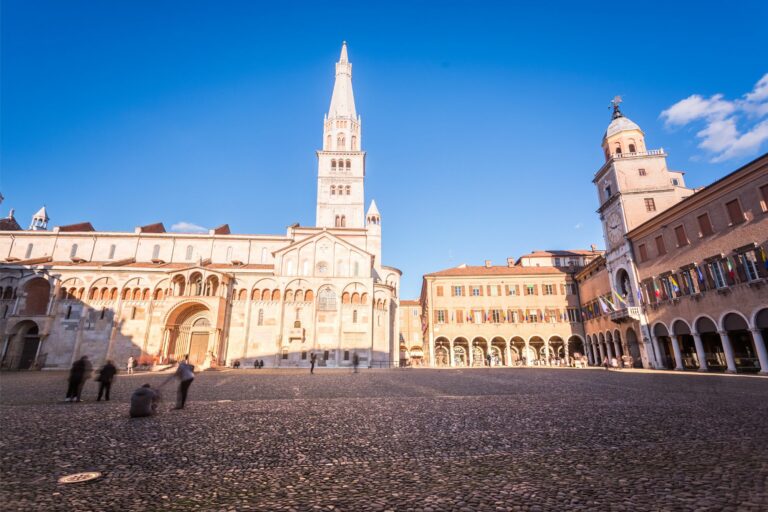
Scandiano preserves within its streets a religious heritage of rare beauty. Its churches are not merely places of worship, but treasure chests of history, art, and popular devotion. Through frescoes, altars, bell towers, and works of art, these sacred spaces bear witness to the deep spirituality that has shaped the area and its traditions. Each church invites visitors on a journey through time and the soul, between memory and faith.
Below is an overview of the main religious buildings in Scandiano.
Parish Church of Santa Maria
The Parish Church of Santa Maria, dedicated to the Nativity of the Blessed Virgin Mary, is a jewel of history and art where spirituality merges with the beauty of centuries-old architecture. Located in Piazza Matteo Maria Boiardo, in the immediate vicinity of the Rocca, it is an imposing testimony to Scandiano’s medieval past. It was built in the first half of the 15th century at the behest of Feltrino Boiardo, designed by an architect from Ferrara. It stands out for its Romanesque style, with elements that recall the simplicity and solemnity of ancient parish churches. The façade is divided into three vertical sections and crowned by a large curvilinear pediment. Inside, there are particularly valuable works, including the painting of Saint Catherine of Alexandria by the Bolognese painter Bartolomeo Passarotti, the canvas depicting the Madonna delle Grazie by the Reggio artist Orazio Talami, and the sculptural group of the Madonna of the Rosary executed by Antonio Baiardi.
Church of San Giuseppe
Located along Via M. Pellegrini, the Church of San Giuseppe is another important religious building in Scandiano. It was built in the first half of the 16th century by the Servite Fathers of the Crocetta on the site of a small chapel previously officiated by the Confraternity of San Giuseppe. The façade, dating from the second half of the 18th century, is divided vertically by six pilasters adorned with capitals, the work of the Reggio architect Francesco Iori; and the elegant bell tower, distinguished by its double profiled frame, attributed to the Reggio A. Bazani. Inside, in addition to the exquisitely executed painting depicting the Marriage of Saint Joseph and Mary by F. Miselli (1759), there are two remarkable carved works: a wooden tabernacle attributed to Francesco Domenico Ceccati (1641–1714) and the organ decoration by the Reggio sculptor Giacomo Cocconcelli (1704). The latter is counted among the finest Baroque woodcarvings that the province of Reggio can boast.
Church of the Capuchins
A few minutes on foot from the Church of San Giuseppe, specifically along Viale San Francesco, is the Church of the Capuchins. It stands next to the convent of the same name and has a history dating back to the early 17th century. Characterized by a simple and austere structure typical of the Capuchin order, it has a tripartite façade surmounted by a central rose window. Inside the church, the altarpiece by the Emilian painter Giuseppe Barnaba Solieri (known as Fra Stefano da Carpi) depicting the Exaltation of Saints of the Franciscan Minor Order stands out on the right-hand wall, showing influences of 18th-century Venetian painting. In the main altar chapel, the wooden tabernacle in the form of a small temple by Fra Fedele da Scandiano is noteworthy. In front of the church, a tree-lined avenue features fourteen Stations of the Cross, created by the Scandiano sculptor Francesco Lodesani.
Church of Santa Maria Assunta
Located in the hamlet of Arceto, the Church of Santa Maria Assunta is a building of very ancient origins, cited in documents as early as the year 1000. Although it was rebuilt in Gothic forms between the late 14th and early 15th centuries, the current bell tower was added at that time. It has a single nave covered with a slightly lowered barrel vault, with three side chapels. Among the numerous artworks present, particular mention goes to the polychrome scagliola altar frontal by Fra’ Felice Gianelli and the painting on the apse wall depicting the Assumption, attributed to Professor Minghetti. In the gallery above the entrance is an 18th-century organ by the Traeri family.
Oratory of San Rocco
Also in the hamlet of Arceto is the Oratory of San Rocco, one of the main examples of popular devotion and local religious architecture. Located within the courtyard of the Castle of Arceto, it was built by the Thiene family in the second half of the 16th century. Inside is a fine scagliola altar frontal, above which is an altarpiece depicting the Madonna and Child with Saint Roch and Saint John the Evangelist, attributed to the painter Bartolomeo Passerotti. Recognized for its significant artistic and devotional value, the painting gained national visibility when it was exhibited at the “San Rocco in Art” exhibition held in Piacenza during the Jubilee of 2000.
Other Places of Worship
Alongside the religious buildings already described, Scandiano also hides other places of worship, smaller but no less evocative. Among these are: the Church of Santa Maria Assunta in the hamlet of Ventoso, whose current structure dates back to the first half of the 17th century; the Church of San Ruffino, Bishop and Martyr, in the homonymous hamlet, first mentioned in a document of 944, with decorations created by the painter Cucchi of Correggio in 1954; and the 17th-century Oratory of Saint Anthony of Padua (known as “del Bucintoro”) in Jano di Scandiano, where several frescoes of notable artistic attribution can be admired.
Photo gallery © Municipality of Scandiano


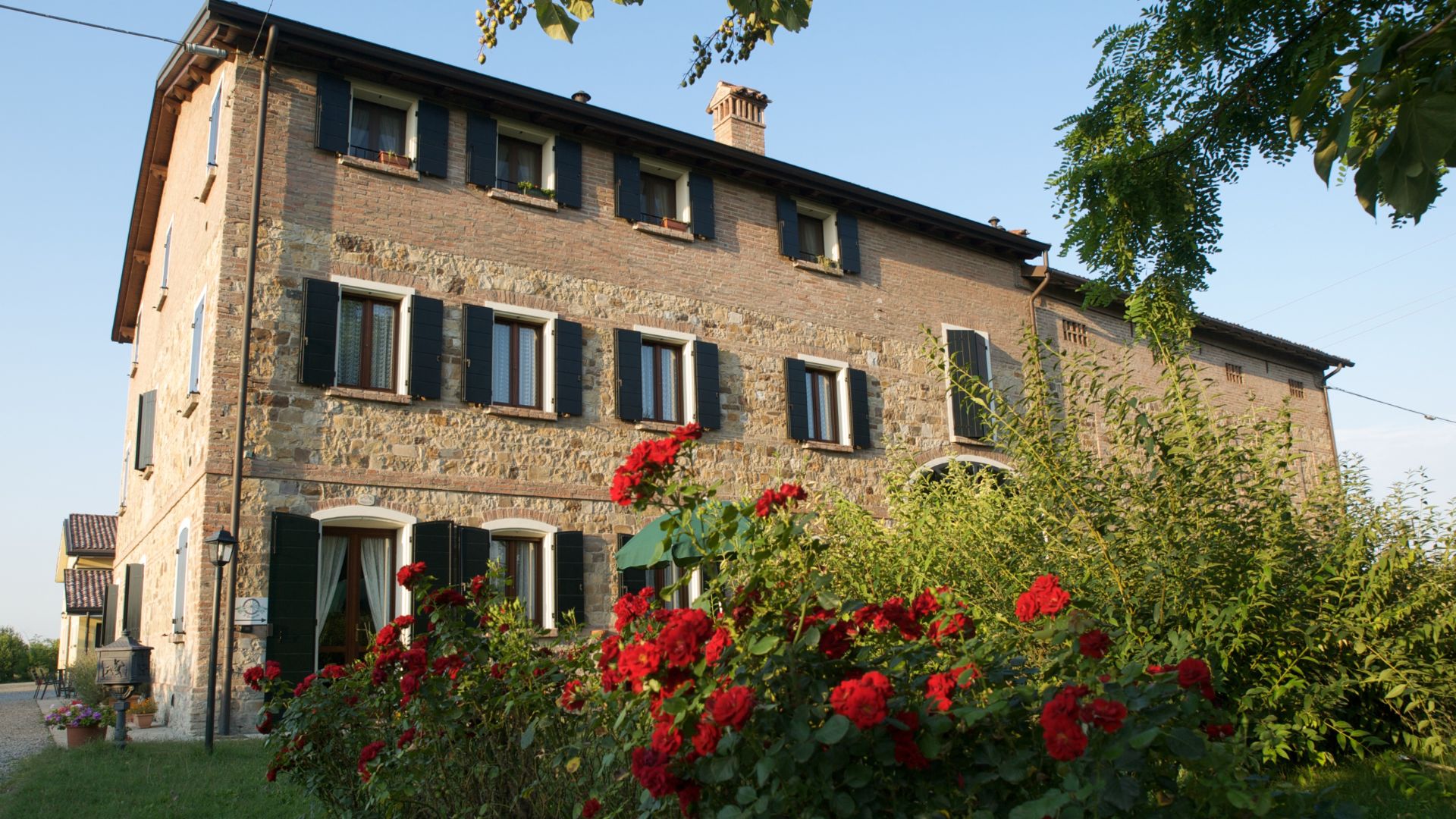
AGRITURISMO IL BRUGNOLO
Welcome to il Brugnolo
If you’re looking for completely independent apartments surrounded by greenery you really are in the right place here!
In fact, Brugnolo is immersed in the green nature of the Emilian countryside. For your relaxation, for that of your children, and again for the runs of your 4-legged friends, you will have 6000 square meters of park at your disposal!