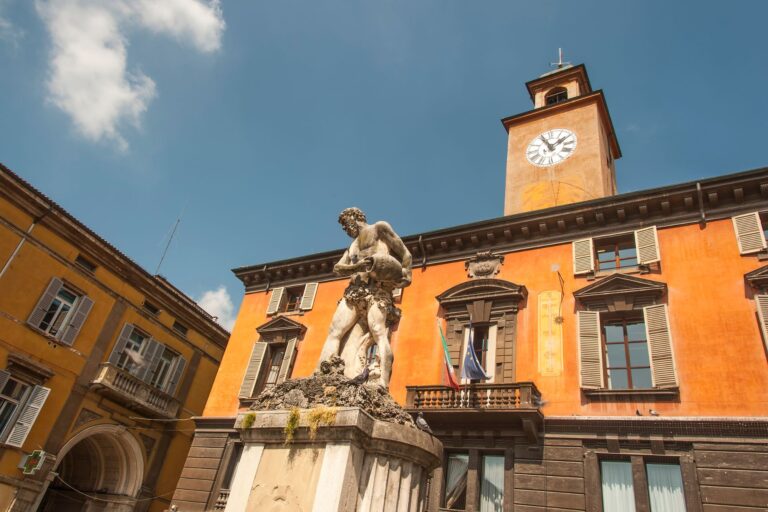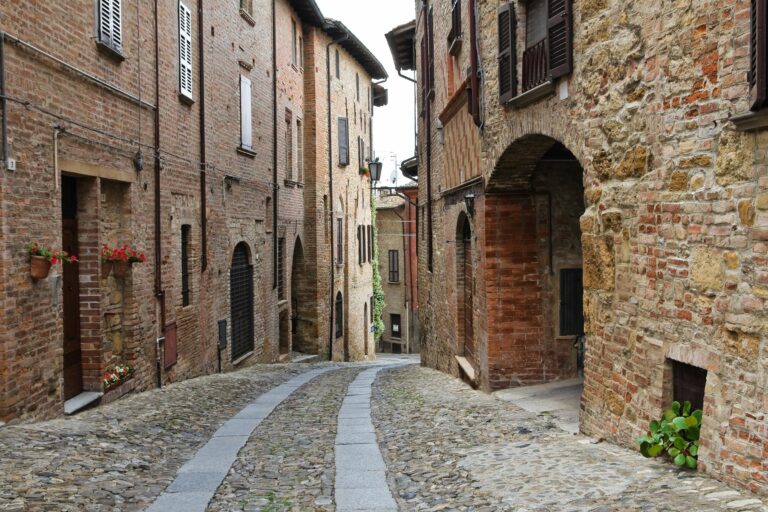
When the days grow longer and the air turns milder, the Modenese hinterland transforms into an extraordinary setting for cycling enthusiasts. The hills take on a deep green hue, the orchards burst into bloom, and the villages seem to awaken after the long winter. Spring is undoubtedly the ideal season to explore this territory by bike: the slow pace of cycling allows you to savour every detail of the landscape.
Here we propose a beautiful route suitable for all types of bikes (gravel, touring, mountain bike).
The route begins in Spilamberto, one of the most charming villages in the Emilian territory, located just over 30 kilometres from our agriturismo. Here you can admire the first of the many towers of the Modenese hills — the Torrione, the village’s symbol, the gateway to the historic centre and an ancient medieval bastion that once defended the town. Today it houses the Antiquarium – Archaeological Museum of Spilamberto, which preserves important evidence from the territory’s prehistoric sites. Before leaving the village, we recommend visiting the Museum of Traditional Balsamic Vinegar, set in the elegant Villa Fabiani. It is well worth learning about the history and meticulous craft behind every single drop of balsamic vinegar. The museum also offers guided tours and tastings.
Following the cycle path along the former railway, you reach the Rocca di Vignola, one of the most interesting examples of fortified architecture in the entire region. Among the interior halls, the Cappella Contrari stands out as a true jewel of late Gothic art in northern Italy. It houses a remarkable cycle of “neo-Giottesque” frescoes depicting: Pentecost; the Resurrection of Christ and his Descent into Limbo; the Ascension; and the Assumption of the Virgin into Heaven with the gift of the girdle — which had been bound around her body — to the Apostle Thomas. Also not to be missed is the Palazzo Contrari-Boncompagni, which stands in the square in front of the fortress. Built to a design by the great Vignola-born architect Jacopo Barozzi, known as il Vignola, it is particularly renowned for its extraordinary helical staircase.
Leaving Vignola and crossing the Percorso del Panaro, you arrive first at Marano sul Panaro and then at Levizzano Rangone (a hamlet in the municipality of Castelvetro di Modena). Here, from mid-March to mid-April, you can admire the spectacular sight of cherry trees in blossom. In this picturesque village, the Castello di Levizzano is well worth a visit. The complex features a circuit of walls at the centre of which stands the so-called Torre Matildica. Today the fortress houses the Museum of Wine and Rural Society – Rosso Graspa, where the history of rural society around the time of the two World Wars is told through numerous testimonies of life in the fields.
The route then continues towards Castelvetro di Modena, along small country lanes that offer sweeping views over the surrounding hills, punctuated by the orderly symmetry of vineyard rows. Upon reaching Castelvetro di Modena, a stop in Piazza Roma is a must — also known as the “chessboard square” for its distinctive black and white stone paving. Overlooking it are the Palazzo del Secondogenito (home to the Town Hall), the Clock Tower, the Prison Tower, and the Palazzo Rinaldi. Leaving the square along Via Torquato Tasso, you reach the imposing Church of Santi Senesio e Teopompo. The building, constructed in an elegant neo-Gothic style, is distinguished by its brick façade with three portals and rose windows, reflecting the internal structure of the three naves.
Leaving Castelvetro di Modena, you continue northward along the cycle path of Via Destra Guerro, which follows the watercourse until it meets the cycle path of the former Modena–Vignola railway. From here, follow the signs for Settecani and finally for Castelnuovo Rangone, the last stop on the route. Once a classic fortified medieval village, Castelnuovo is today a pleasant provincial town, known for its meat processing industry, where fascinating traces of its medieval past can still be found. Must-see highlights include: the iconic bronze piglet in Piazza Papa Giovanni XXIII, created by Dutch sculptor Kee Sansen; and the MUSA – Museum of Salumeria, which traces the history, knowledge, and production techniques of a gastronomic art that in these parts carries an almost religious significance.
Photo gallery (1) © Terre di Castelli | (2 and 3) © Visit Castelvetro


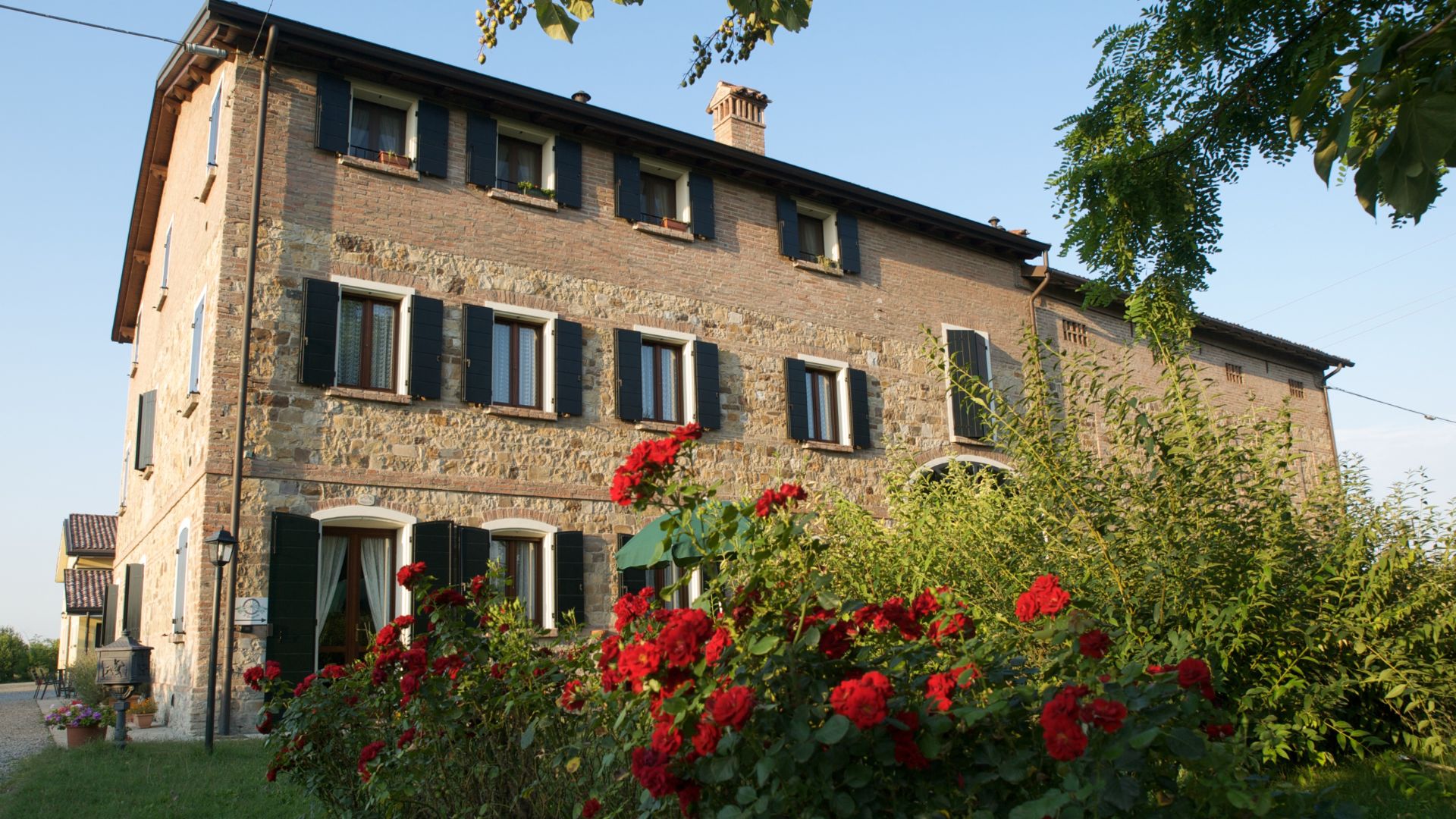
AGRITURISMO IL BRUGNOLO
Welcome to il Brugnolo
If you’re looking for completely independent apartments surrounded by greenery you really are in the right place here!
In fact, Brugnolo is immersed in the green nature of the Emilian countryside. For your relaxation, for that of your children, and again for the runs of your 4-legged friends, you will have 6000 square meters of park at your disposal!