
Lungo la via delle Ville (Along the Via delle Ville) is a cycle route that takes you past historic residences, enchanting gardens and unique landscapes, stretching from the historic centre to the outskirts of Reggio Emilia.
The starting point is Piazza Gioberti. Located at the gates of the Jewish ghetto, it is named after Vincenzo Gioberti, one of the protagonists of the Italian Risorgimento. Here, where the Crostolo stream once flowed, stands the elegant Palazzo Ducale (open to the public during the opening hours of the Prefecture and the offices of the Province of Reggio Emilia) and begins the 18th-century promenade, a route of about 7 kilometres that winds from the historic centre of Reggio Emilia to the Reggia di Rivalta. The square is dominated by an elliptical basin and the large obelisk erected in 1843 in honour of Adelgonda of Bavaria, wife of Duke Francesco V, later dedicated to the martyrs of the Risorgimento.
Continuing along Corso Garibaldi, you reach Piazza Roversi, also known as Piazza del Cristo, named after the beautiful Baroque church that overlooks it. The building was constructed as an oratory (to preserve a miraculous fresco of the Holy Cross, painted in oil on plaster by an anonymous artist from Reggio Emilia during the plague of 1630-31) and later transformed into a church during the 18th century. In front of the Church of Christ, a pool of water has been placed in memory of the bed of the Crostolo stream that used to flow here before it was diverted outside the city walls.
The Porta Castello intersection connects the 18th-century promenade with Viale Umberto I. Designed by the ducal architect Ludovico Bolognini, it has a monumental soul and great historical and symbolic value. The boulevard is renowned for its more than 400 trees arranged in four double rows: two double rows of lime trees lining the road and inner avenues and two double rows of different species lining the outer avenues. The route continues to the Crostolo Bridge, where you can admire two statues that belonged to the Ducal Villa of Rivalta, representing the Panaro and Secchia rivers.
We now immerse ourselves in Crostolo Park, commonly known as Parco delle Caprette (Goat Park) due to the presence of several Tibetan goats, which roam freely within the area. Walking along the Crostolo stream, we arrive at the Reggia di Rivalta, one of the last Delizie Estensi (Estense Delights). This magnificent palace was built starting in 1723, modelled on the Palace of Versailles. Of the original building, which was plundered during the Napoleonic occupation, only the south wing (probably intended for servants) and the chapel (incorporated into agricultural buildings) remain, while of the park and gardens, only the fenced perimeter and a partially ruined oval pool remain.
The route then continues to Villa d’Este, a splendid 18th-century structure that was part of the larger project of the Reggia di Rivalta. Immersed in greenery, it is surrounded by the Vasca di Corbelli, an artificial basin now used for sport fishing, built to collect water from the Crostolo River and feed the Reggia’s fountain system. The original idea was conceived by architect G. M. Ferraroni, but the project was certainly carried out by G. B. Bolognini and his brother Francesco. The villa is only open for special events, but you can walk or cycle along the reservoir and enjoy a bit of relaxation in the shade of the trees.
The next stop is Villa Levi, a neoclassical building dating back to the 17th century located in the hamlet of Coviolo. It takes its name from the Jewish family who owned it from 1874 to 1956 and is considered one of the most unique villas in the Reggio Emilia countryside due to its distinctive architecture and rich history. Inside, the majestic central hall and dome are particularly noteworthy, while outside, the complex is surrounded by a splendid 4-hectare park boasting numerous species and “monumental” trees: field and mountain maples, white hornbeams, English oaks, ash trees, horse chestnuts, tulip trees, hazelnuts, plane trees and lime trees; among the many evergreens, you can admire firs, cedars, cherry laurels, pines, yews and thujas.
Following the wall of the Coviolo cemetery and riding along the cycle path on Via Fratelli Rosselli, you will reach the Consorzio Vacche Rosse dairy, where, in addition to purchasing excellent Parmigiano Reggiano, you can take part in guided tours to discover all the stages of production of the ‘King of Cheeses’, from milk processing to moulding, including the traditional spinning process. To the left of the dairy is the 18th-century Villa Gastinelli, the last stop on the itinerary. Designed by architect Carlo Lari, it takes its name from the surname of the general of the same name who purchased it from the Liberati Tagliaferro Counts. The complex, built in the second half of the 19th century, is surrounded by a park, which is one of the most evocative features of the property.
Photo © Nicola Tampelloni – Wikipedia
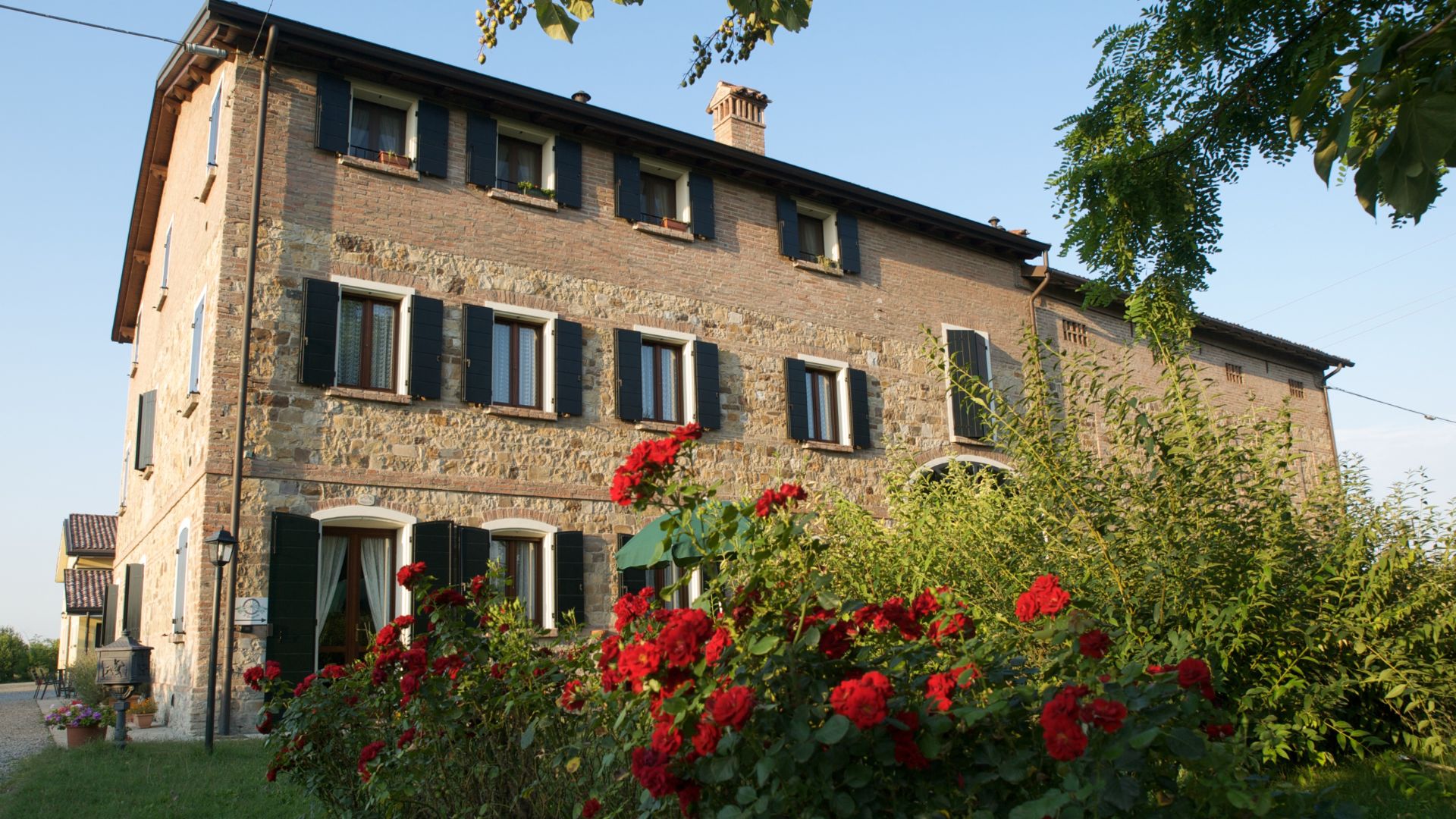
AGRITURISMO IL BRUGNOLO
Welcome to il Brugnolo
If you’re looking for completely independent apartments surrounded by greenery you really are in the right place here!
In fact, Brugnolo is immersed in the green nature of the Emilian countryside. For your relaxation, for that of your children, and again for the runs of your 4-legged friends, you will have 6000 square meters of park at your disposal!


